
One of the Music Industry’s Biggest Labels is Quietly Becoming a Patent Powerhouse
Iain Russell, Founder & Director, Russell IP, and MTUK’s Patents Expert
As part of the “Patented Inventions That Have Changed How We Make and Hear Music” series, we consider the potential impact of AI on artists’ and labels’ ability to enforce rights.
Universal Music Group (UMG) is behind some of the world’s biggest artists. It has also become an active patent filer in the AI-music space. This recent Music Business Worldwide investigation dug into a growing patent portfolio backed by UMG which claims more than 60 protected innovations.
The artist-approval machine
One of the granted patents in the portfolio is titled “AI-Generated Music Derivative Works” (US12322402B2). The idea: when a fan asks an AI to remix a track, the system checks whether the artist would approve before anything gets released. If it passes, the output gets a digital watermark plus terms set by the rightsholder. The patent also describes watermarks that expire, letting an artist automatically revoke approval after a licensing term has elapsed.
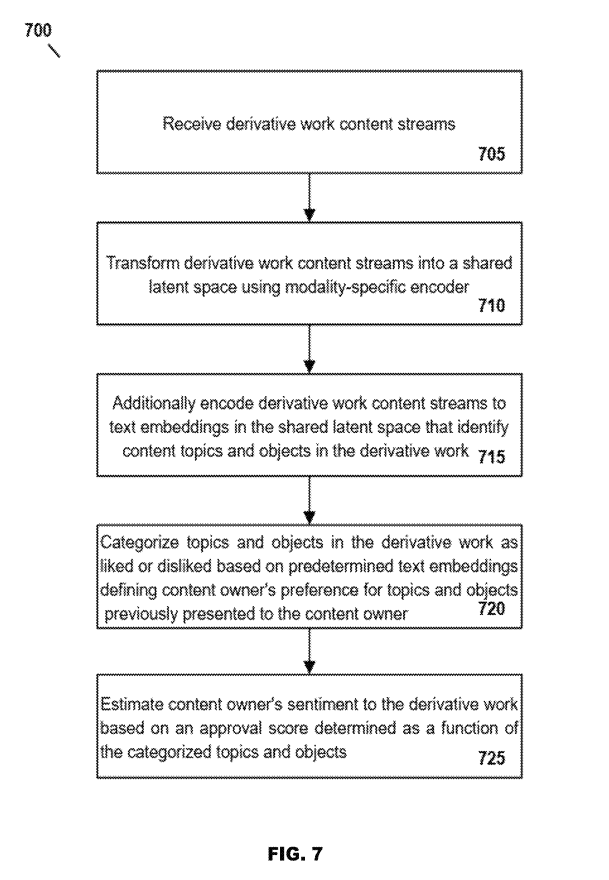
Workflow from the patent, including the step “Estimate content owner’s sentiment to the derivative work based on an approval score determined as a function of the [artist’s liked and disliked] topics and objects”
Knowing the artist’s preferences
Follow-up filing “Multi-Stage Approval and Controlled Distribution of AI-Generated Derivative Content” (US12423388B2) adds a second layer of checks – one before the AI generates anything, another on the finished product. The filing gives a very specific example of how granular this can get:
“If an artist is vegetarian and does not want their voice or style to be used in songs about meat consumption, this preference can be captured by their label ahead of time.”
It’s not every day that a patent application refers to an artist’s dietary choices! But it’s a vivid illustration of where AI rights management could head: not just can this be used, but would this artist actually want it used this way.
From songs to T-shirts
A third filing extends the same approval-and-watermark logic beyond audio altogether, into AI-generated merchandise – album artwork, apparel, posters, even virtual goods for the metaverse. As described in “AI-Generated Derivative Content Scaling for Merchandise” (US12632517B2), a fan picks a source asset (a lyric, a tour visual, an artist’s logo), the AI generates design options, and the same approval system decides whether a T-shirt reading “Stage is my canvas” gets made, – or whether “Music is just noise!” gets rejected before it reaches a print queue.
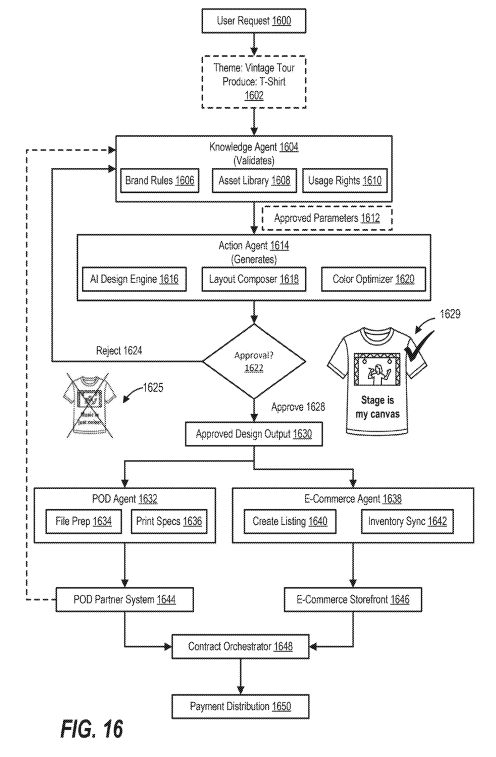
Flow diagram from the merchandise patent
Automating enforcement
A further patent application, “Media rights platform systems and methods” (US20260044583A1), published in February 2026, take things a step beyond approval and watermarking into enforcement. It describes an “LLM Agent Copyright Crawler” that scans the open web, detects embedded watermarks, and checks what it finds against active licences. When something doesn’t match, the system doesn’t just flag it for a human to deal with. According to the patent application, the system is designed to go ahead and send “one or more cease-and-desist letters to user or streamer” – with a human only brought in if things escalate. While many lawyers might be uncomfortable with the idea of cease-and-desist letters being sent out without human review, just describing something in a patent application doesn’t mean the feature will necessarily be used.
There’s also a chatbot front-end, designed to plug directly into platforms including ChatGPT and Claude, that interrogates would-be licensees about their intended use before clearing or rejecting a request. And underneath it all sits a dynamic pricing engine – adjusting licensing costs in real time based on demand.
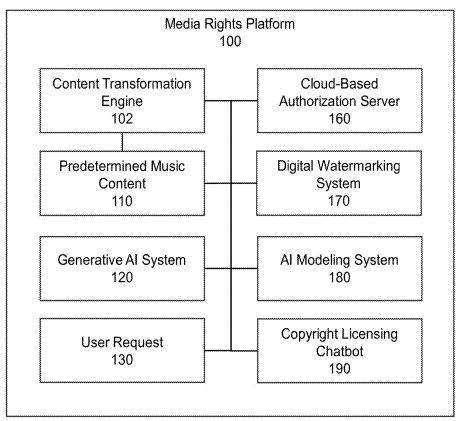
Diagram from the “copyright crawler” patent application showing the “copyright licensing chatbot”
Conclusion: Another New Music-Technology Frontier
AI has already had far-reaching consequences in music technology, impacting music creation, editing and production; listening habit analysis and song recommendations; and music teaching and learning, among many other things. These UMG patent applications and patents add a new dimension to AI’s potential influence in the field, possibly changing the way artists and their labels seek to engage with fans and maintain their brands in ways which haven’t been practical before. Of course, granted patents don’t guarantee that the protected technology will be adopted, but they can give an interesting insight into what could be round the corner.